
Rare Blackjack Variants and Their Practical Advantages
Blackjack has evolved into a broad family of formats, many of which remain unfamiliar to the wider audience. Less common variants continue to appear in both land-based venues and licensed online environments, offering distinct rule sets that influence house edge, round length and strategic depth. Understanding these formats helps players make informed choices and adapt their approach to rule-driven conditions that can significantly affect expected value.
Single-Deck Switch Blackjack
Single-Deck Switch Blackjack is an uncommon hybrid version that merges the fast pace of single-deck play with the mechanic of exchanging the top cards of two separate hands. Unlike standard Switch, the single-deck structure reduces the overall number of cards in circulation, which directly affects probability calculations and card-tracking consistency. This hybrid format is typically available in specialised gaming venues that focus on niche rule sets.
One of the key distinctions lies in how the switch mechanic interacts with a single deck. Because the card pool is smaller, the expected distribution becomes more predictable, allowing experienced players to calibrate decisions more precisely. The reduced deck also slightly decreases volatility across multiple sessions, although the benefit depends on the house rules applied to soft totals and dealer behaviour on soft 17.
In 2025, operators who offer this variant generally apply moderate rules, including the possibility to double after a switch and restrictions on switching after splits. These conditions influence the effective house edge, which typically ranges from 0.40% to 0.60% when optimal strategy is applied. As with most rare variants, exact figures vary by venue due to differences in payout tables and dealer stand requirements.
Advantages of Single-Deck Switch Blackjack
The ability to exchange cards between two hands provides strategic flexibility not found in classic single-deck blackjack. When used correctly, the switch mechanic can convert borderline totals into stronger hands or reduce the risk profile of weak combinations. This makes the format attractive for players who favour tactical adjustments rather than rigid decision-making based on standard matrices.
The smaller deck assists with probability-driven choices. Players who keep track of exposed cards can recognise shifts in card concentration earlier than in multi-deck versions. For those confident in advanced play, this can translate into slightly improved decision accuracy over long sessions.
Consistency is another advantage. Because the card pool resets frequently and the deck is reshuffled more often, the game avoids the dilution effect common in six- or eight-deck versions. This leads to rounds that feel more aligned with calculated expectations, which is useful for analytical players seeking a stable rule framework.
European No-Hole-Card Blackjack
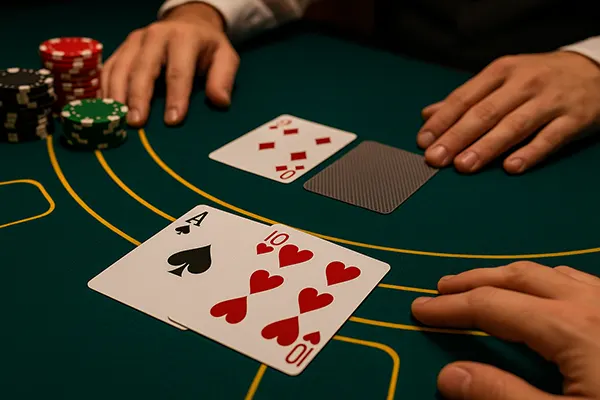
European No-Hole-Card Blackjack remains a relatively rare ruleset outside the EU. The defining feature is that the dealer receives only one card at the beginning of the round and draws the second card only after players complete their hands. This rule alone alters the risk landscape because players may lose doubled or split stakes when the dealer subsequently reveals a natural blackjack.
In 2025, the version is still found primarily in regulated European markets and a limited selection of specialist venues globally. The absence of an initial hole card changes the expected value of decisions on hard doubles, soft doubles and certain splits. Optimal strategy for this format differs from that of classic American rules and requires separate decision charts for accurate play.
The house edge in European No-Hole-Card Blackjack is typically around 0.62% with standard rules, rising or falling depending on restrictions on doubling and whether the dealer stands or hits on soft 17. Because this format discourages overly aggressive doubling, the game tends to favour players who prefer careful, risk-controlled progression rather than expansionary stake patterns.
Advantages of European No-Hole-Card Blackjack
This format promotes measured decision-making. Since the dealer’s natural blackjack is unresolved until after all player actions, participants learn to manage exposure on doubled and split stakes more cautiously, which cultivates disciplined bankroll control. The emphasis on risk-aware decisions makes the game suitable for analytical players.
The simplified initial layout — with only one dealer card visible — streamlines early evaluation. While this reduces the volume of available information, it allows players to focus on probabilistic ranges rather than fixed assumptions about the dealer’s total. This approach helps refine long-term strategic thinking.
Another practical advantage is transparency: because the dealer does not pre-check for blackjack, the round proceeds without interruptions. This leads to a more continuous pace, giving sessions a steady rhythm valued by players who favour uninterrupted flow.
Double-Attack Blackjack
Double-Attack Blackjack is a rare variant rooted in Atlantic City rules, characterised by its unique pre-deal “attack” wager. Players may increase their initial stake after seeing the dealer’s upcard but before receiving their own cards. This single rule significantly alters risk-reward dynamics and makes the game appealing to players who enjoy tactical stake calibration.
The variant typically uses an eight-deck Spanish configuration, removing tens from the deck but retaining face cards. This change affects natural blackjack probabilities and shifts the mathematical structure of card distribution. Because the sequence of cards becomes more dependent on mid-value ranks, players must adjust their expectations regarding dealer bust frequencies and optimal hit-stand thresholds.
In 2025, Double-Attack Blackjack remains a niche offering, primarily found in a limited number of US land-based venues and a few licensed international environments that provide specialist table games. When played with standard rules, including even-money blackjack payouts and late surrender, the house edge can vary between 0.35% and 0.70% depending on how frequently players use the attack option.
Advantages of Double-Attack Blackjack
The option to increase the stake after analysing the dealer’s upcard introduces a controlled form of situational aggression. Players gain the opportunity to adjust exposure according to statistically favourable upcards, creating additional layers of tactical decision-making not present in traditional blackjack formats.
The Spanish deck composition leads to higher frequencies of active decision scenarios. Because tens are removed, dynamics such as dealer bust potential, player double values and split expectations differ from classic rules. This encourages thoughtful recalibration of standard strategy, leading to more engaging sessions for players who appreciate mathematical nuance.
The availability of late surrender provides an additional protective mechanism for bankroll preservation. When applied correctly, surrender decisions can offset some of the increased variance introduced by the attack mechanic, resulting in a more balanced risk profile over extended play.
The most popular articles
-
 Double Double Bonus Video Poker: Who This ...
Double Double Bonus Video Poker has been around for years, yet it …
-
 Side Bets in Baccarat: A 3-Step Sanity Fil...
Side bets in baccarat are marketed as small add-ons, yet in practice …
-
 Blackjack Surrender Rule: When Giving Up I...
Surrender is one of the most misunderstood options in blackjack because it …